
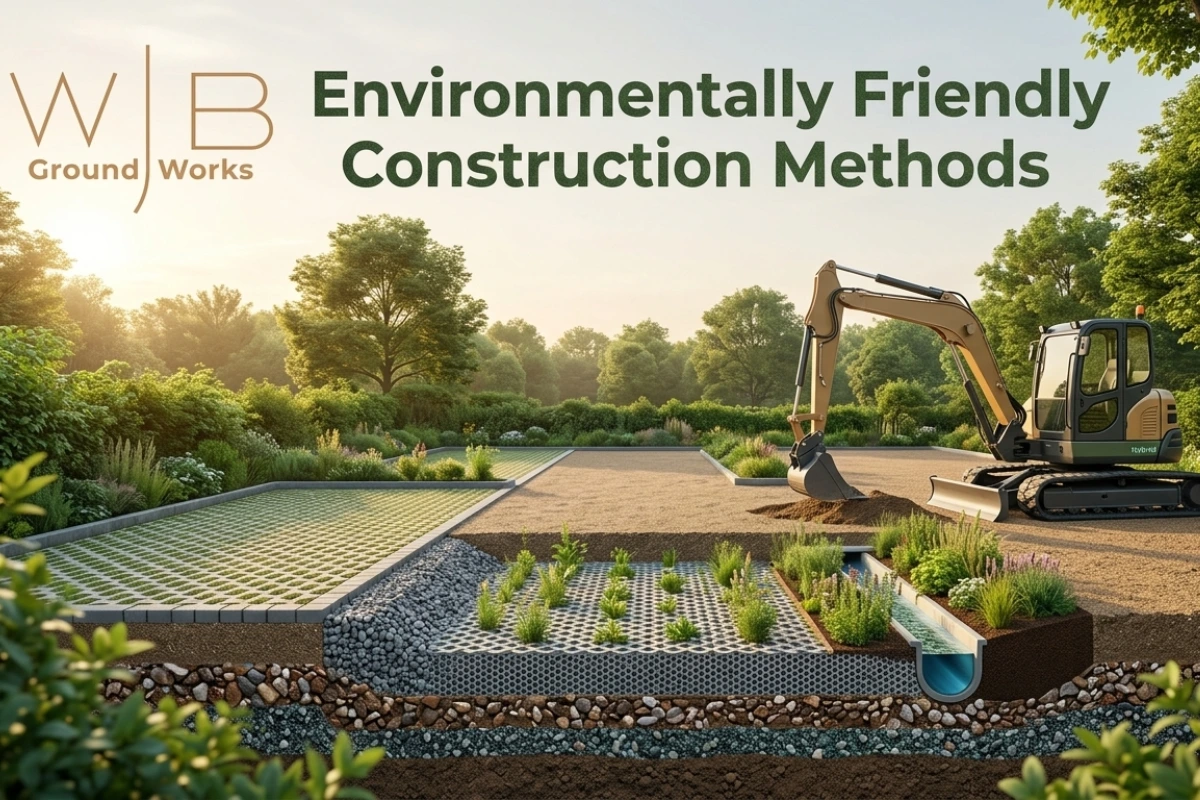
The construction industry significantly impacts the environment through carbon emissions and resource depletion to waste generation and energy use. Green building practices aim to minimise these effects throughout a structure's complete lifecycle by reducing emissions, conserving resources, minimising waste, improving efficiency, and creating healthier spaces.
This guide explains twenty key environmentally friendly construction methods, the sustainable materials behind them, their benefits, and the challenges involved in putting them into practice.
Mass timber and CLT are carbon-sequestering alternatives to steel and concrete. Timber stores the carbon absorbed by trees during their growth, reducing the embodied carbon of structural elements. CLT panels are strong, lightweight, and suited to a wide range of building types from residential to commercial.
Biochar can be added to cement mixes to trap atmospheric CO₂ within the structure itself. This approach reduces the overall carbon footprint of concrete while maintaining structural performance, making it one of the more promising low-carbon material innovations currently in use.
Repurposing existing structures rather than demolishing and rebuilding avoids the embodied carbon associated with new construction. Retrofitting existing buildings with improved insulation, glazing, and mechanical systems extends their lifespan and significantly reduces their energy consumption.
Passive design leverages natural sunlight, building orientation, thermal mass, and ventilation to reduce the need for mechanical heating and cooling. When properly applied, it can dramatically cut operational energy use without adding complexity or cost to the mechanical systems.
Manufacturing building components off-site under controlled conditions reduces material waste by up to forty percent compared with traditional on-site construction. Modular construction also shortens programme, reduces site disruption, and improves quality control.
Low-E glass reflects infrared light, reducing heat gain in summer and heat loss in winter. Smart glass variants can adjust their tint automatically in response to sunlight, providing passive thermal control and reducing reliance on artificial lighting and air conditioning.
Vegetation layers on rooftops provide insulation, manage stormwater runoff, support biodiversity, and reduce the urban heat island effect. Living roofs are increasingly specified on commercial and residential projects as part of broader sustainability strategies.
Mycelium insulation panels are made from fungal root networks grown on agricultural waste. They are fully biodegradable, have good thermal and acoustic properties, and represent a genuinely circular material that can return to the soil at end of life.
Self-healing concrete contains bacteria that activate when cracks form, producing calcium carbonate to seal the damage naturally. This extends the service life of structures, reduces maintenance requirements, and lowers the long-term material costs associated with repair and replacement.
Artificial intelligence tools optimise material ordering, waste prediction, energy scheduling, and logistics across construction projects. By reducing over-ordering and improving delivery timing, AI can meaningfully cut both material waste and operational carbon on large schemes.
Calcined clay cement, also known as LC3, replaces a proportion of clinker in cement production with calcined clay and limestone. This reduces the CO₂ footprint of cement by nearly fifty percent compared with conventional production while maintaining equivalent structural performance.
Processed to remove its colour while retaining its structure, translucent wood is a biodegradable alternative stronger than glass. It can be used in windows and facades, bringing natural light into buildings while offering better thermal performance than conventional glazing.
Closed-loop graywater treatment and reuse systems allow buildings to recycle water on-site. Combined with rainwater harvesting, these systems can dramatically reduce mains water consumption and the associated energy and treatment costs tied to water supply and disposal.
Additive manufacturing for concrete reduces material consumption by up to sixty percent compared with traditional formwork methods. It also allows complex structural forms to be produced with precision, shortening build times and reducing labour on repetitive structural elements.
Designing buildings so that components can be separated and reused at end of life is one of the most impactful circular economy strategies available. It keeps materials in use longer, reduces demolition waste, and supports future building programmes without the need for new raw materials.
Geothermal systems leverage the earth's constant underground temperature to heat and cool buildings with minimal electricity input. Ground source heat pumps are well-established technology and provide highly efficient thermal regulation across a wide range of building types.
Bamboo is a rapidly renewable material with tensile strength comparable to steel. It can be used as a structural rebar alternative in concrete and as a primary structural element in appropriate climates, offering significant carbon benefits over conventional reinforcement.
Producing steel from recycled scrap consumes seventy-five percent less energy than manufacturing virgin steel. Specifying recycled steel for structural frames, reinforcement, and cladding systems is one of the simplest ways to reduce the embodied carbon of a new building.
Exterior cladding panels that chemically trap atmospheric CO₂ are entering mainstream construction. These products actively remove carbon from the air throughout their service life, turning the building envelope into a carbon management tool rather than simply a weather barrier.
Incorporating natural elements such as planted walls, daylight, natural ventilation, and water features into building design supports occupant wellbeing and reduces energy needs. Buildings designed with biophilic principles often achieve better health outcomes for users alongside improved environmental performance.
Alongside the methods described above, the materials specified on a project have a direct bearing on its environmental performance. The following materials are widely recognised as high-performance sustainable options:
The shift towards environmentally friendly construction methods delivers a wide range of advantages for developers, occupants, and the wider environment:
Despite the clear benefits, implementing environmentally friendly construction methods is not without difficulty. The most common challenges include:
The construction industry is transitioning towards sustainable practices not as an optional extra but as a necessity for a sustainable future. Despite the implementation hurdles, environmentally friendly construction methods offer significant long-term environmental and economic benefits that justify the effort and investment required.
At WJB Ground Works, we are committed to delivering groundworks, drainage, and civil engineering services in a responsible and considered manner. If you are planning a project and want to work with a contractor who takes sustainability seriously, contact our team to discuss your requirements.
The most widely adopted methods include passive design, prefabrication and modular construction, use of recycled and low-carbon materials, geothermal heating and cooling, and design for disassembly. Each addresses a different aspect of a building's environmental impact.
A method is considered environmentally friendly when it reduces carbon emissions, conserves natural resources, minimises waste, improves energy efficiency, or creates healthier environments for occupants without depleting finite materials.
Sustainable construction often carries higher upfront costs, but the long-term savings in energy, maintenance, and operational expenses typically offset the initial investment. Many sustainable buildings also achieve higher valuations and attract stronger tenant demand.
The most recognised certification schemes in the UK include BREEAM (Building Research Establishment Environmental Assessment Method), LEED (Leadership in Energy and Environmental Design), and Passivhaus. Each sets measurable performance standards across energy, water, materials, and ecology.
Yes. Sustainable groundworks practices include using recycled and secondary aggregates, minimising spoil haulage distances, specifying low-carbon concrete mixes, implementing SUDS drainage solutions, and reducing fuel consumption through efficient plant scheduling and GPS-guided equipment.
Consult with our specialists and book an on-site inspection at your convenience. Contact us at 01784740573, or email us at info@wjbgroundworks.com for a bespoke quote. Visit our portfolio and explore the projects we have conducted successfully.