
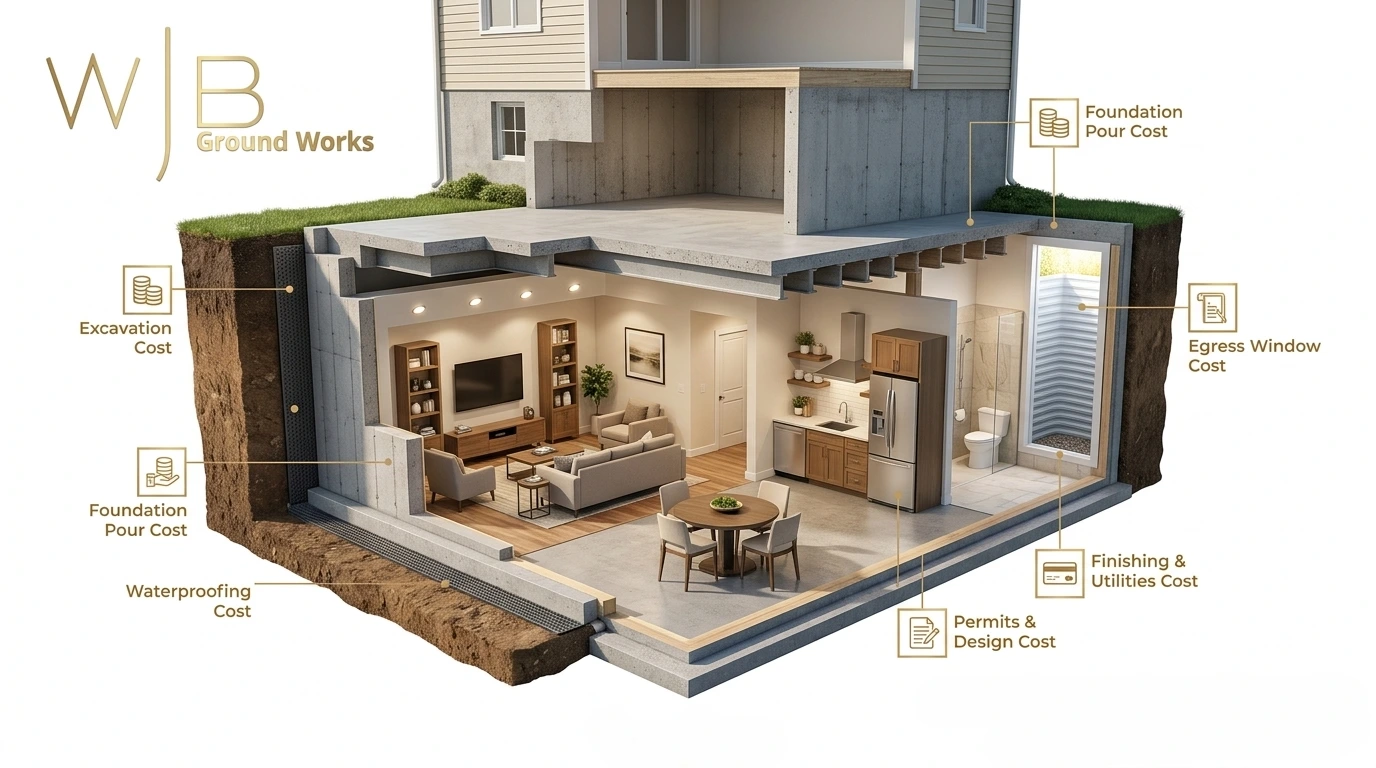
A basement can completely transform how a home feels. But getting there takes more than just a good idea. One family, dozens of opinions. Some picture the basement as a cosy movie theater, while others might want something functional. Maybe a storage haven, a home office, or a rental unit.
Well, putting opinions is only the beginning. What’s next? Now comes the expense talks. Envisioning is the starter course. The main course is always the budget.
Before you start ground work and the shovel hits the ground, the big question comes up. How much does it cost to build a basement? The answer isn’t exactly straightforward. Typically, a basement building costs £3,000 to £5,000+ per square metre. But the exact pricing depends on a bunch of things like property size, soil conditions, waterproofing, finishes, etc.
Today, we’ll break down the basement construction cost, what may drive the cost, and determine if it’s worth the investment. Let’s begin.
A basement building involves a ton of things. Highly technical, sequential process. Let’s dig into the costs for each phase of a basement building process step-by-step according to the industry benchmarks:
| Cost Type | Sub-Item | Average Range |
|---|---|---|
| Architectural Design Fees | Concept and Planning Drawings | £3,000–£6,000 |
| Technical Design and Tender Package | £5,000–£8,000+ | |
| Structural Engineering | Basic Calculations | £1,500–£3,000 |
| Complex Sub-Grade Design | £5,000–£10,000 | |
| Party Wall Agreements | Surveyor Fees | £1,000–£2,000 |
| Terraced Row Complexity (if applies) | £3,000–£5,000 | |
| Specialist Ground and Site Surveys | Geotechnical and Soil Survey | £1,000–£2,000 |
| Hydrological/Water Table Survey | £500–£1,200 | |
| CCTV Drainage Survey | £250–£500 | |
| Asbestos Survey | £300–£600 | |
| Planning & Building Control Permits | Planning Application Fee | £258 |
| Basement Impact Assessment | £2,000–£4,000 | |
| Building Regulations Inspection Fee | £1,000–£2,500 |
| Cost Type | Sub-Item | Average Range |
|---|---|---|
| Bulk Excavation (plant+labour) | Open Cut Excavation | £1,200–£1,600 |
| Retrofit Excavation | £2,000–£3,500 | |
| Muck Away and Soil Waste Disposal | Grab Lorries | £300–£450 per load |
| Skip Hire | £250–£350 per 8-yard skip | |
| Suspended Parking Bay Permits | £50–£150 per day | |
| Temporary Structural Support & Propping | Piles and Shoring | £4,000–£10,000 |
| Acrow Props and Needles | £3,000–£6,000 | |
| Soil Types – Running Sand and Silt | Continuous Interlocking Piling | £8,000–£18,000 |
| Chemical Grouting | £5,000–£12,000 | |
| Soil Types – Heavy Clay | Muck Away Premium | £30–£50 extra per tonnes |
| Shoring & Bracing | £2,000–£5,000 extra | |
| Soil Types – Solid Rock/Bedrock | Specialist Plant Hire | £450–£850 per day |
| Labour Overruns | £3,000–£8,000 | |
| Cost Type | Sub-Item | Average Range |
|---|---|---|
| Mass Concrete Underpinning | £1,200–£1,800 | |
| Piled Underpinning | Plant Hire Costs | £1,500–£3,500 per week |
| Casing and Grouting | £80–£130 per linear metre | |
| Reinforced Concrete Floor Slab | Steel Reinforcement | £900–£1,400 per tonne |
| Waterproof Concrete Additives | £30–£50 per m³ extra | |
| Structural Steel Framework (RSJs) | Steel Fabrication | £2,500–£3,500 per tonne |
| Installation and Lifters | £600–£1,200 per day | |
| Fireproofing | £1,500–£3,000 | |
| Cost Type | Sub-Item | Average Range |
|---|---|---|
| Barrier Protection (Traditional Cementitious Tanking) | Substrate Preparation | £20–£35 per m² |
| Slurry Application | £40–£80 per m² | |
| Drained Protection (Cavity Drain Membrane Systems) | Wall and Floor Membrane | £80–£150 m² |
| Perimetre Drainage Channels | £25–£45 per linear metre | |
| Structurally Integral (Waterproof Concrete) | £15–£40 per m² | |
| Active Mechanical Drainage (Sump and Dual Pump Systems) | Sump Chamber Installation | £1,500–£2,500 baseline |
| Dual-Pump Upgrade | £800–£1,500 extra | |
| Battery Backup Power Unit | £800–£1,400 | |
| High Water Alarms | £200–£450 | |
| Ongoing Maintenance Costs | Flushing & Jetting | £250–£450 per visit |
| Annual Pump Servicing | £150–£300 per year | |
| Cost Type | Sub-Item | Average Range |
|---|---|---|
| Upgraded Consumer Unit (fuse box) | £600–£1,200 | |
| Zoned LED Lighting Circuit | £80–£120 per light point | |
| Moisture-Resistant Fittings | £400–£800 | |
| Dedicated Audio-visual and Data Cabling | £1,000–£3,500 | |
| Cost Type | Sub-Item | Average Range |
|---|---|---|
| Macerator or Lifting Station Box | £800–£2,000 | |
| Plumbing Supply Run | £40–£70 per linear metre | |
| Main Sewer Backwater Valve | £300–£600 | |
| Cost Type | Sub-Item | Average Range |
|---|---|---|
| Mechanical Ventilation and Heat Recovery | £2,000–£4,500 | |
| Underfloor Heating | £75–£120 per m² | |
| Cost Type | Sub-Item | Average Range |
|---|---|---|
| Framing Costs | Timber Framing | £25–£40 |
| Metal Stud Framing | £35–£55 | |
| Insulation Costs | PIR Rigid Foam Boards | £20–£35 per square metre |
| Mineral Wool/Rockwool Batt Insulation | £10–£20 per square metre | |
| Spray Foam Insulation | £45–£75 per square metre | |
| Vapour Control Layer | £5–£10 | |
| Cost Type | Sub-Item | Average Range |
|---|---|---|
| Drywall Costs (Supply and Fix) | £23–£35 per m² | |
| Plaster Skimming | £15–£30 per m² | |
| Flooring Costs (Supply and Installation) | LVT (Luxury Vinyl Tile) | £40–£85 per m² |
| Engineered Wood (Basement Grade) | £60–£110 per m² | |
| High-quality Carpet and Thick Underlay | £30–£65 per m² | |
| Joinery, Doors, and Trims | Internal Doors | £150–£300 per door |
| Skirting and Architrave | £12–£20 per linear metre | |
| Painting Costs | £150–£325 per day | |
| Wall & Ceiling Finishes | £8–£25 per m² | |
Planning a basement project carefully from the start helps prevent budget overruns and costly delays. Still, several hidden factors can push basement construction to cost higher than you might expect. Let’s dig into the most significant cost drivers:
For many homeowners, the answer is yes.
A basement adds usable square footage without expanding the home outward. That extra space can become a guest suite, a home gym, a rental apartment, a game room, or whatever you want it to be.
Finished basements can also increase property value. Buyers often see them as a major bonus.
There’s also the lifestyle factor. Families grow. Storage fills up. Working from home becomes normal. A basement creates flexibility that many homeowners eventually need.
Of course, the return depends on build quality, design, and local housing demand. But in many cases, a well-built basement becomes one of the most useful parts of the house.
So, How Much Does It Cost To Build A Basement? The truth is, there’s no one-size-fits-all price. But at least now you know the probable ranges.
Some might hesitate to invest in a basement, but it genuinely offers long-term value. It creates extra living space, improves functionality, and can even boost resale potential.
Work with experienced contractors like WJB Ground Works, budget realistically, and never overlook waterproofing or structural safety. A properly built basement can serve a family for decades.
In the UK, basement construction costs between £3,000 and £5,000+ per square metre. London basement projects are often more expensive due to access restrictions and higher labour costs.
In many cases, yes. Planning permission may be required, especially for large excavations, listed buildings, or properties in conservation areas. Building regulations approval is also usually necessary.
Basement waterproofing costs from £100 to £120 per square metre. The total project’s waterproofing may fall between £4,000–£17,500+.
Yes. Walkout basements usually require additional excavation, retaining walls, drainage systems, and exterior finishing work, which increases overall construction costs.
Basement projects typically take 1 to 2 weeks for a raw foundation and up to 3 to 5 months for a fully retrofitted finished space.
Yes, it does. A finished basement with features like guest rooms, home offices, and entertainment areas is especially attractive to buyers.
Not necessarily. Modern basements with proper insulation, waterproofing, and heating systems can feel just as comfortable as the rest of the house.
Consult with our specialists and book an on-site inspection at your convenience. Contact us at 01784740573, or email us at info@wjbgroundworks.com for a bespoke quote. Visit our portfolio and explore the projects we have conducted successfully.