
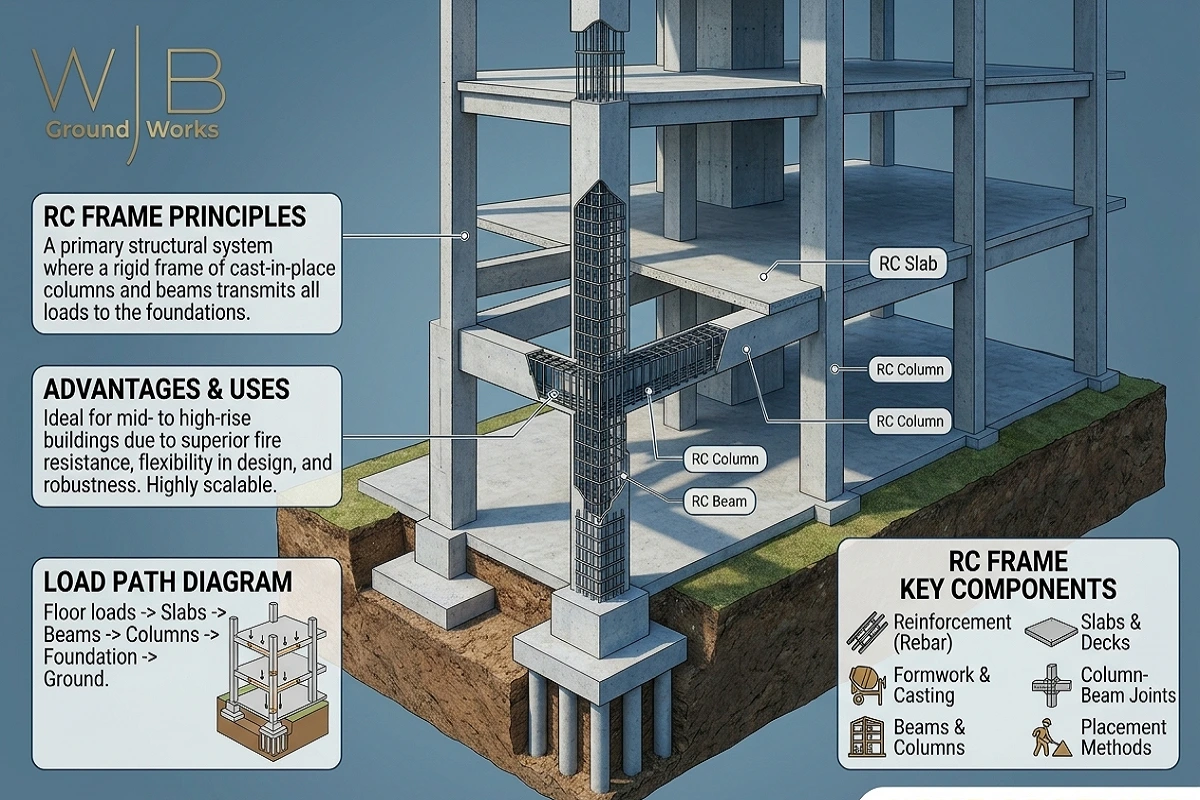
Modern cities are like a living fantasy, standing with pride. Tall apartments. Office towers. Shopping malls. Industrial buildings. Behind many of these strong and long-lasting structures, there’s a common method. That’s RC frame construction, one of the most widely used construction systems in the world. RC frame is renowned worldwide because of its durability, flexibility, and ability to handle heavy loads.
From residential homes to skyscrapers, reinforced concrete frame structures have become the backbone of modern architecture. Understanding RC frame construction is crucial, especially for people who are interested in knowing modern building methods.
So what is RC frame construction? In this guide, you will learn how the RC frame system works, what it includes, its construction techniques, major applications, benefits, and challenges. Ready to discover? Let’s get in.
RC frame construction stands for Reinforced Concrete Frame Construction. It is a structural system where a building is supported by a framework made of reinforced concrete.
The frame mainly consists of columns, beams, slabs, and foundations that work together to transfer the building load safely to the ground.
Concrete is naturally strong in compression but weak in tension. To overcome this weakness, steel reinforcement bars, commonly called rebars, are embedded inside the concrete. This combination creates a highly durable and strong structural system known as reinforced concrete.
In buildings constructed by an RC frame, the load is carried by the frame rather than the walls. This means the walls mainly act as partitions or enclosures. Because of this feature, architects and engineers get more freedom in designing open spaces and flexible layouts.
RC frame structures are typically used in:
An RC frame system is made up of several important structural elements. Each component plays a critical role in maintaining the building’s strength and stability. RC frame construction resists heavy loads, wind pressure, fire, and even earthquakes when properly designed. Always choose reputed professionals like WJB Ground Works for RC frame construction.
Here’s what’s inside an RC frame system:
Columns are vertical structural members that transfer loads from beams and slabs down to the foundation. They are one of the most important parts of the reinforced concrete frame. The size and reinforcement of columns depend on a building’s height, structural load, soil conditions, and design requirements. A strong column ensures the entire structure remains stable over time.
Beams are horizontal structural elements that connect columns together. Their main job is to carry loads from slabs and transfer them to the columns. RC beams are carefully reinforced with steel bars to handle bending and tension forces.
Slabs form the floors and roofs of a building. They distribute loads evenly to beams and columns. Common slab types in RCC construction are:
The slab design and type depend on the building layout and expected load.
The foundation safely transfers the building’s load to the soil. Without a strong foundation, even the best RC frame structure can fail. Common foundation types include isolated footings, raft foundations, pile foundations, and combined footings. The choice of foundations depends on soil bearing capacity and structural requirements.
Steel reinforcement bars improve the tensile strength of concrete. Different diameters and grades of steel are used based on structural calculations. Proper reinforcement placement is crucial for load resistance, crack control, earthquake resistance, and structural longevity.
Concrete is the core material of RC frame construction. It is made by mixing cement, sand, aggregates, and water. Admixtures may also be added to improve strength, workability, or curing time.
Different reinforced concrete frame construction techniques are used depending on the project size, complexity, and speed requirements.
Cast-in-situ construction is the most traditional and widely used reinforced concrete frame construction technique. In this method, all structural components are built directly at the construction site. Concrete is poured into temporary formwork after reinforcement bars are installed.
The process begins with setting up shuttering or formwork for columns, beams, slabs, and foundations. Steel reinforcement is then placed to improve tensile strength. Once the reinforcement inspection is completed, concrete is poured and compacted using vibrators to remove air gaps. Cast-in-situ RCC construction is commonly used for residential buildings, commercial structures, bridges, and high-rise developments.
Advantages:
Drawbacks:
Precast concrete construction is becoming increasingly popular due to its speed and quality control advantages. In this method, reinforced concrete elements are manufactured in a controlled factory environment before being transported to the site for assembly. Precast components may include beams, columns, wall panels, staircases, slabs, and facade units.
Factory-controlled manufacturing ensures precise dimensions, better surface finishes, and consistent concrete strength. It is widely used in commercial buildings, modular construction, parking structures, warehouses, and large infrastructure projects.
Advantages:
Drawbacks:
Slip form construction is a highly efficient technique used mainly for tall vertical structures. It is commonly applied in towers, chimneys, silos, bridge piers, and core walls of high-rise buildings. In this method, the formwork moves continuously upward while concrete is poured in a steady process. The continuous pouring system speeds up construction and reduces the number of construction joints.
Advantages:
Drawbacks:
Post-tensioned concrete construction is an advanced RCC technique designed to improve structural efficiency and span capability. It uses high-strength steel tendons placed inside ducts within the concrete members. After the concrete hardens, the tendons are tensioned using hydraulic equipment and anchored firmly. This process compresses the concrete internally, increasing its resistance to cracking and deflection.
This construction method is commonly used in bridges, shopping malls, stadiums, parking garages, airports, and high-rise commercial buildings.
Advantages:
Drawbacks:
Earthquake-resistant reinforced concrete frame construction is specially designed for seismic-prone regions. The primary goal is to improve structural flexibility, ductility, and energy absorption during earthquakes. Special reinforcement detailing techniques are used to strengthen beam-column joints and prevent sudden structural failure. Shear walls are added to resist lateral forces generated by seismic movement.
Advantages:
Drawbacks:
Jump form construction is another advanced RCC technique used for vertical concrete structures. Unlike slip form systems, jump forms move upward in stages rather than continuously. After one section of concrete gains adequate strength, the formwork is lifted to the next level using cranes or hydraulic systems. Jump form construction provides high accuracy and cleaner finishes for vertical elements such as elevator cores, shear walls, and tall building shafts.
Advantages:
Drawbacks:
Flat slab construction is a modern reinforced concrete framing system where slabs are supported directly by columns without deep beams. This creates a flat ceiling surface and simplifies architectural layouts. The absence of beams reduces floor height and allows easier installation of electrical and mechanical services. This technique is commonly used in offices, hotels, hospitals, and apartment buildings.
Advantages:
Drawbacks:
Tunnel form construction combines wall and slab casting into a single operation using large steel formwork systems. Concrete walls and slabs are poured simultaneously to create strong box-type structural units. It is commonly used for high-rise apartments, hotels, hospitals, dormitories, and large-scale mass housing projects with repetitive layouts.
Advantages:
Drawbacks:
RC frame construction is used in almost every sector of the modern construction industry, following building regulations. Here are the key applications of the system:
Like every construction method, RC frame construction has both strengths and limitations. Let’s have a look at them:
Understanding “what is RC frame construction” gives you valuable insight into how modern structures are designed and built to last. It has transformed the modern construction industry. Its combination of concrete and steel creates a strong, durable, and highly versatile structural system suitable for everything from homes to skyscrapers.
The popularity of reinforced concrete frame construction comes from its ability to handle heavy loads, resist fire, support flexible designs, and provide long-term durability. While it does have some challenges like longer curing times, its advantages still make it one of the most trusted building systems worldwide.
If you need expert RC frame contractors in London, WJB Ground Works is here to help with professional reinforced concrete frame construction services tailored to your project requirements.
An RC frame in construction is a structural framework made from reinforced concrete. It consists mainly of columns, beams, slabs, and foundations that support the building and transfer loads safely to the ground.
RC construction stands for Reinforced Concrete Construction. It combines concrete with steel reinforcement bars to improve structural strength and durability.
The average life of an RCC building is typically around 70 to 100 years when properly designed, constructed, and maintained.
Water penetration, corrosion of reinforcement steel, chemical attacks, and poor maintenance are among the biggest enemies of concrete structures. Over time, these factors can weaken the RCC frame.
RC construction offers high strength, durability, fire resistance, earthquake resistance, low maintenance, and excellent design flexibility.
Yes, under ideal conditions and with proper maintenance, some concrete structures can last close to 200 years.
RCC construction is generally better for multi-story and modern buildings because it offers greater strength, flexibility, and earthquake resistance. Load-bearing structures are better suited to smaller buildings.
Steel structures are lighter and faster to construct, while RCC buildings offer better fire resistance, durability, and lower maintenance. The best choice depends on the project type and budget.
Consult with our specialists and book an on-site inspection at your convenience. Contact us at 01784740573, or email us at info@wjbgroundworks.com for a bespoke quote. Visit our portfolio and explore the projects we have conducted successfully.